Members Edit: Glossary of Emotions
Opening 14 Nov, 4-6pm
14 Nov - 23 Jan 2027
11-5pm
Members Edit
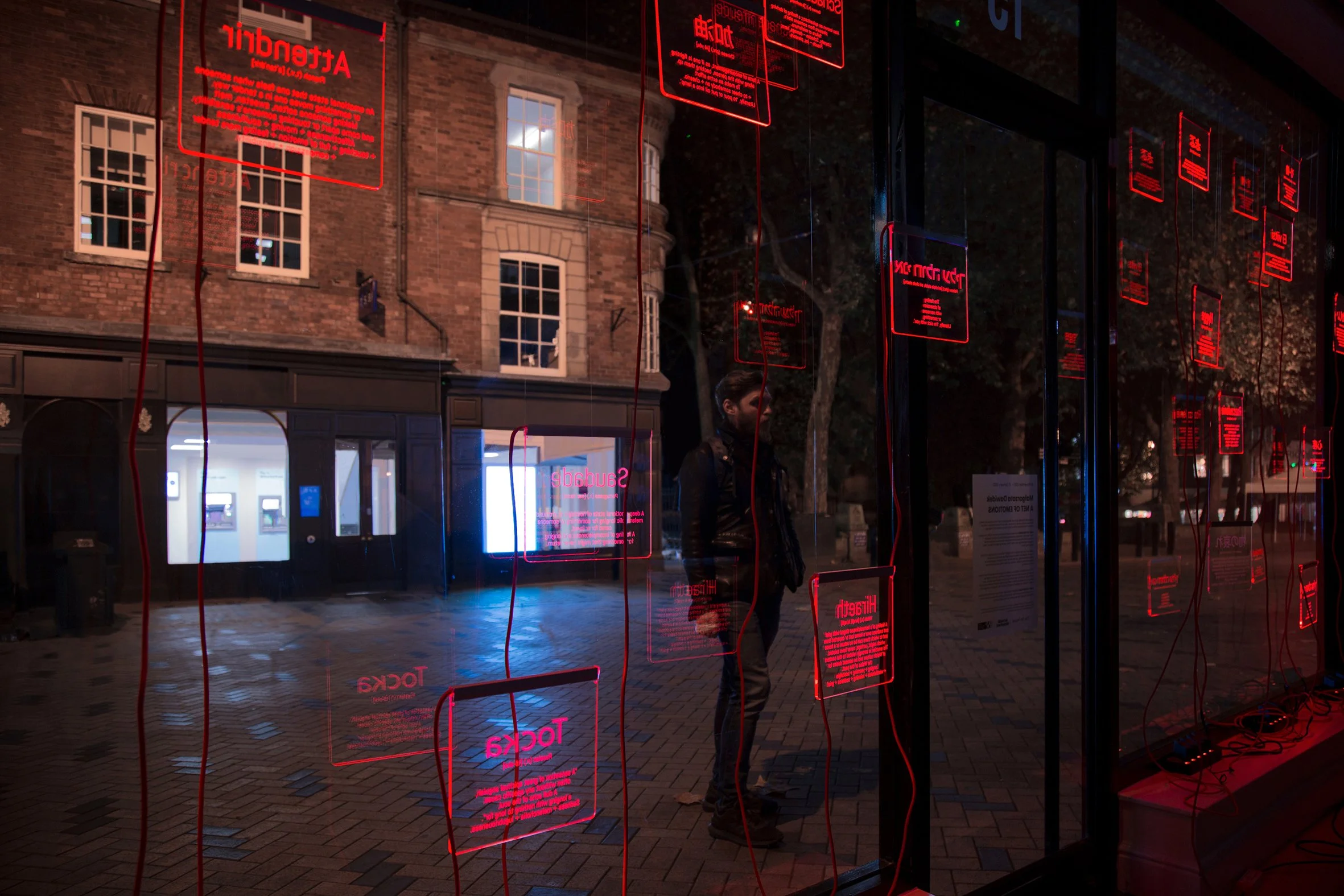
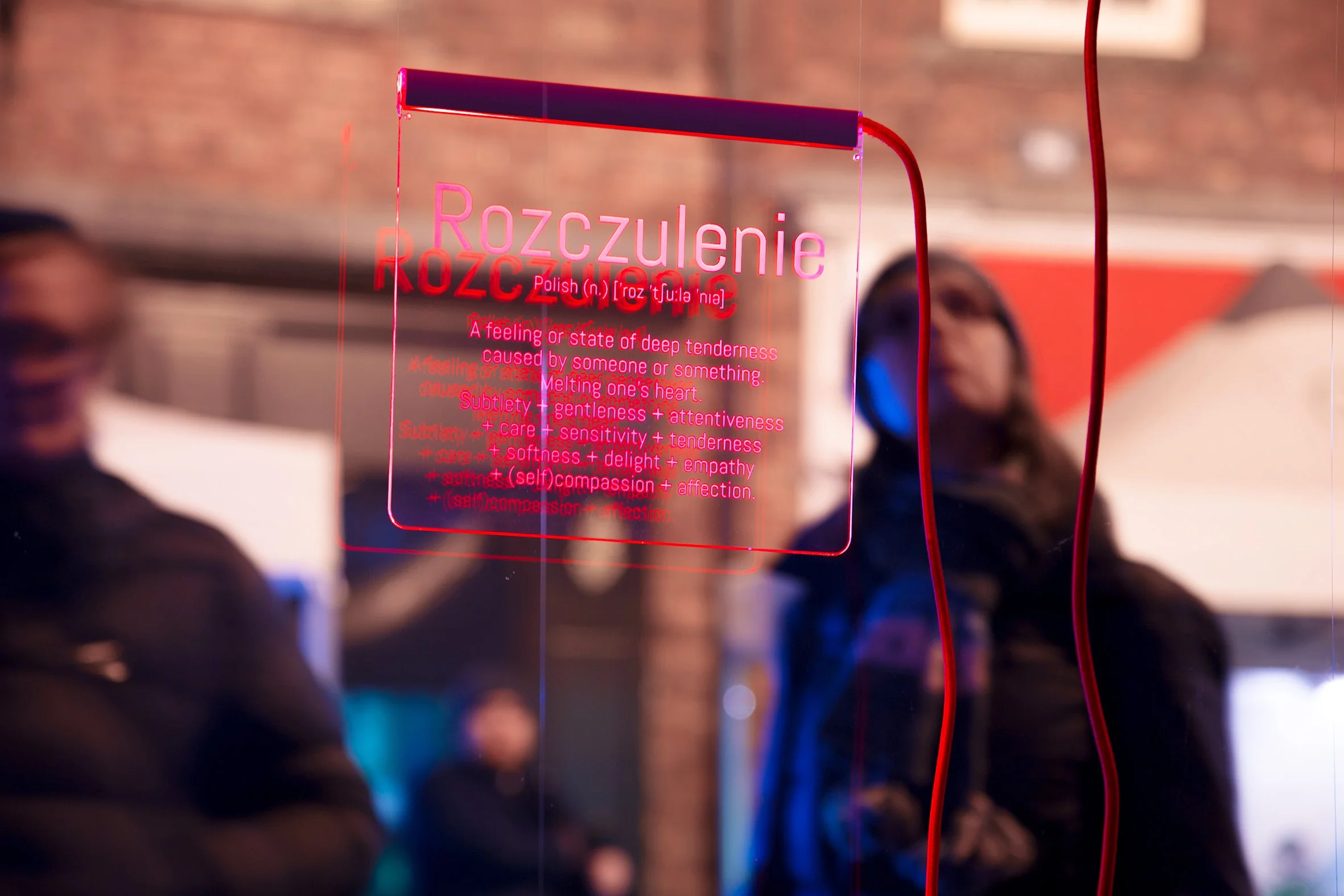
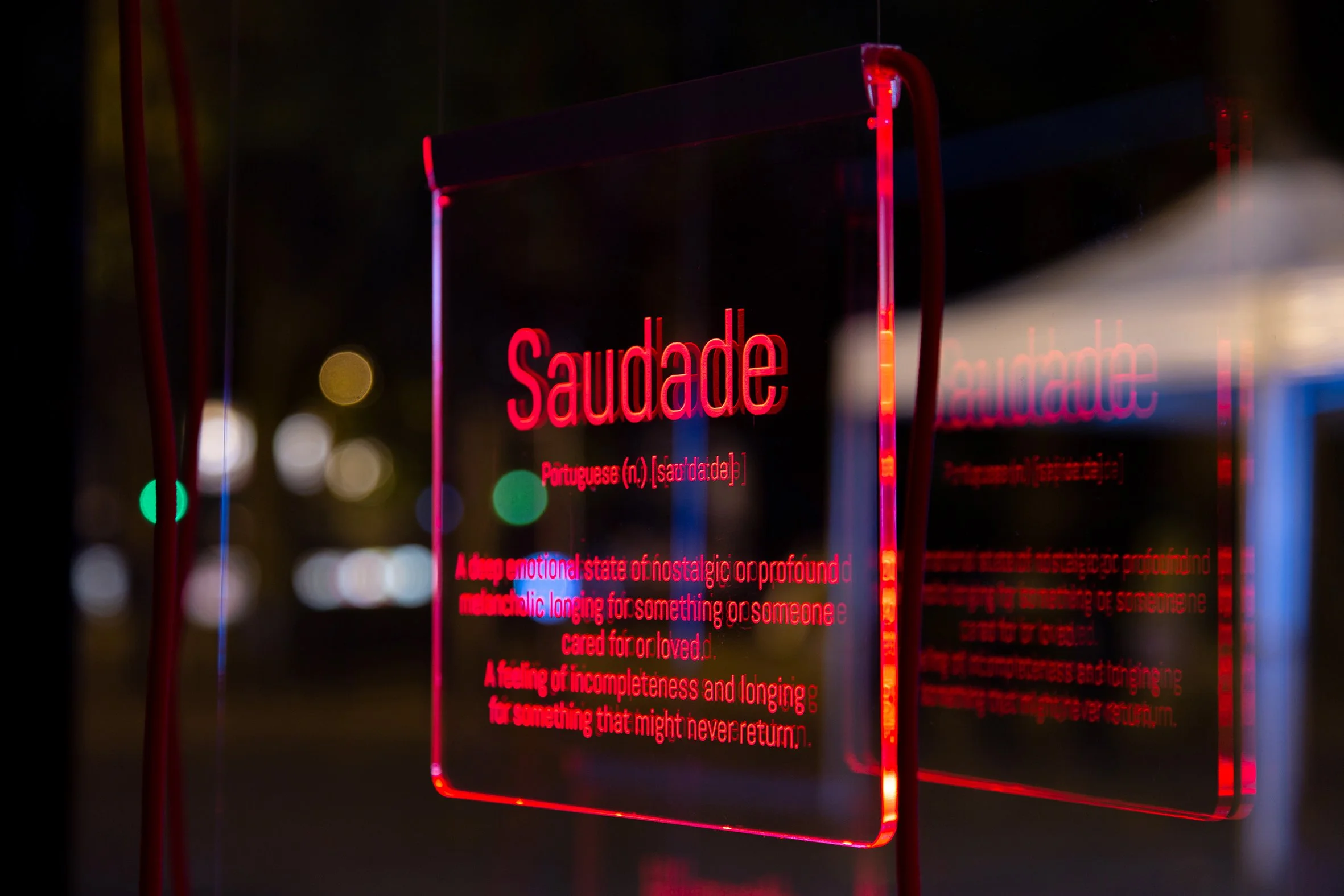
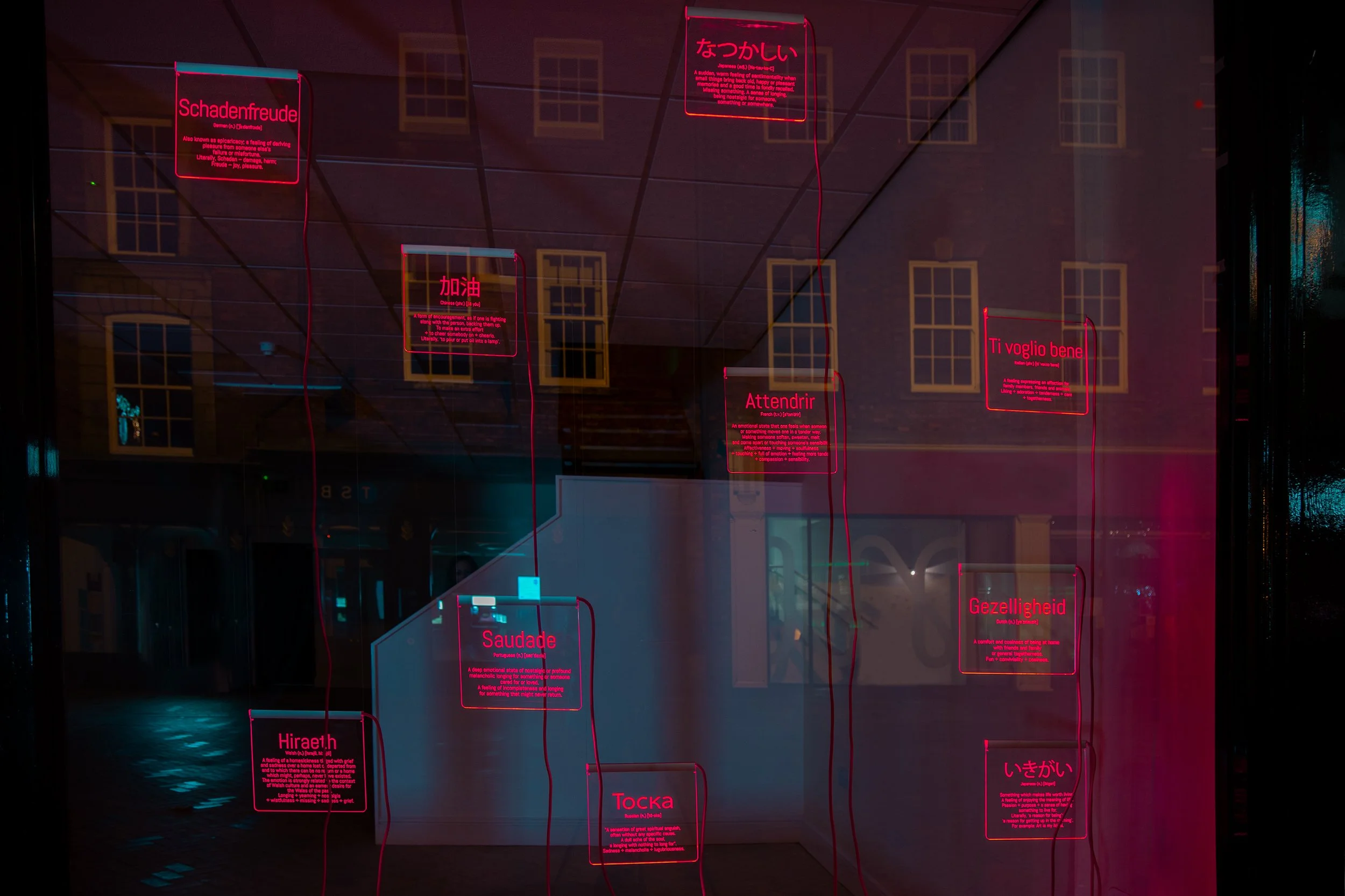
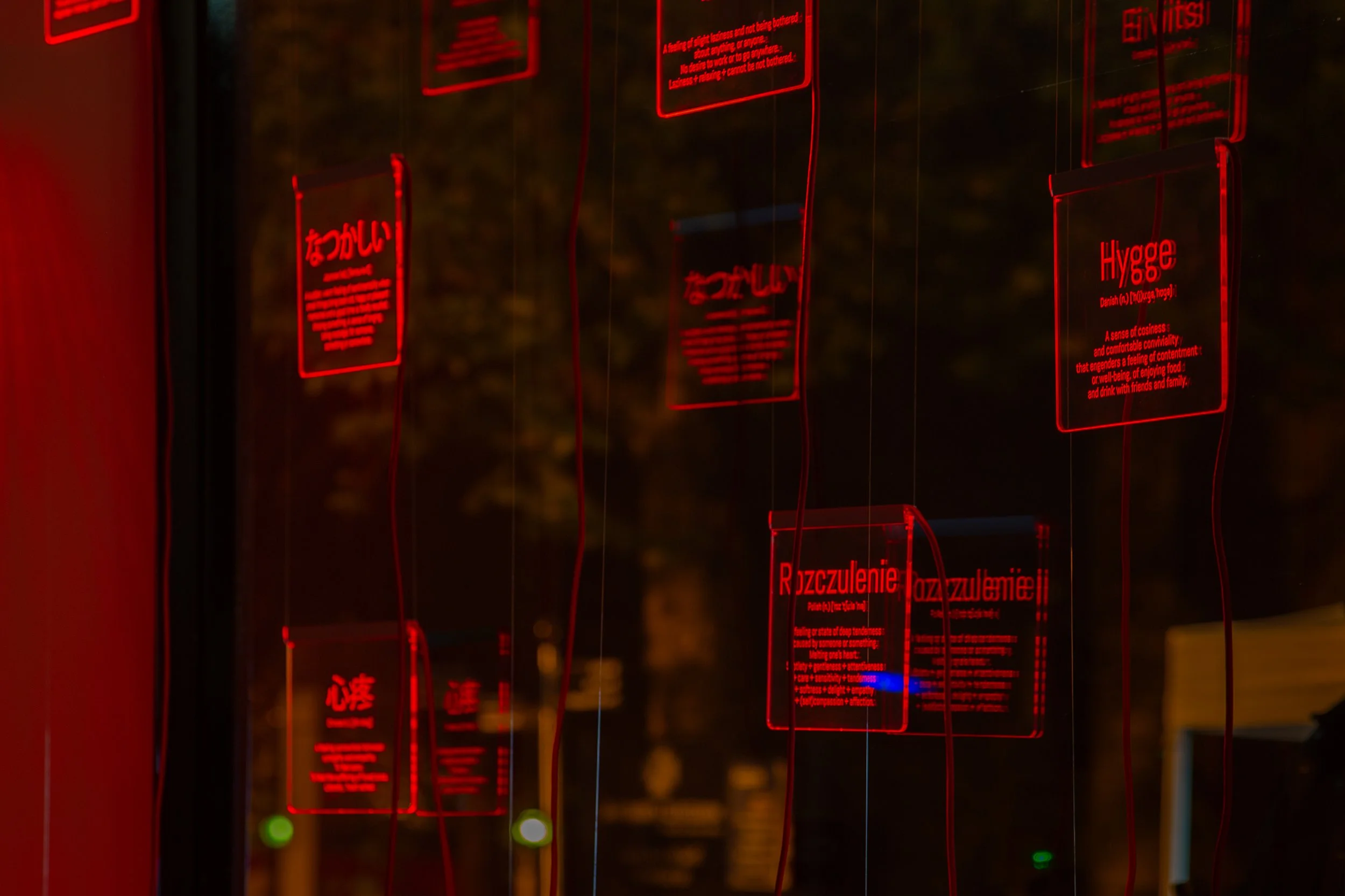
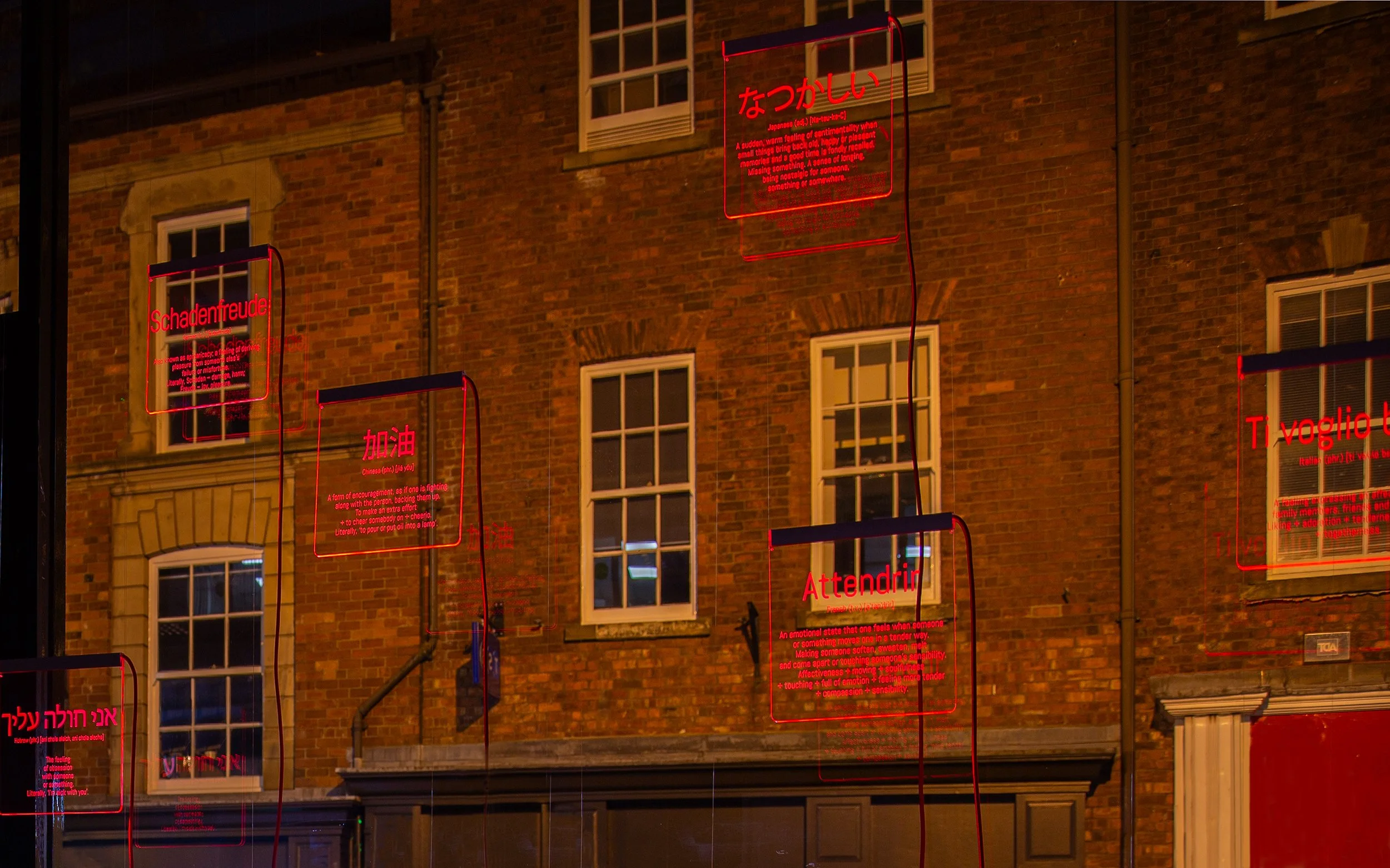
Glossary of Emotions by Małgorzata Dawidek is our fourth Members Edit at Bloc Projects. A light-and-text-based installation that contributes to a critical debate on identity, boundaries and the role of language and art in expressing emotions in multicultural communities. The work consists of thirty LED light plates on which the names of emotions with no English equivalents have been engraved. It demonstrates that emotions for which there are no terms in one language can be expressed in another. In this way, the work creates a bridge between different European and non-European cultures. Each plate contains definitions from languages such as Polish, Ukrainian, Estonian, Lithuanian, Russian, Chinese, Japanese, Korean, Portuguese, Hebrew, German, French, Swedish, Danish, Welsh and many others. A collection of plates in which individual emotions are situated within local cultural contexts forms a multilingual emotional dictionary.
Dawidek analyses the value and strength of cultural and linguistic identity against the backdrop of processes of globalisation. By looking at the ways in which human emotionality is expressed, the artist explores and exposes how the specificity of language can be used to transgress the unification produced by the Western world and the English language, recognised as a contemporary Lingua Franca. Her project highlights the power of multilingual communication as a formative value in seeking commonalities, creating social bonds and building horizons of hope. It shows that language and communication serve as both a protection and a tool, providing a sense of security in the critical experience of migration. Combining artistic and linguistic media, Dawidek’s work opens a space for reflection on inclusivity, tenderness, proximity and care. It also draws attention to the significance of the linguistic exchange of knowledge as a force for empowering human relationships with respect for diversity and the potency to create communities. The exhibition at Bloc Project will feature a selection of works from the Glossary of Emotions collection, complemented by the serigraphy A Wheel of Emotions, which illustrates the connections between basic and derived human emotions and feelings. Małgorzata Dawidek thanks the international group of artists, translators and linguists whose expertise and insights informed Glossary of Emotions: Florence Biteghe, Yvonne Feng, Nayoung Jeong, Irene Man, Nir Segal, Caryl Swift and Shino Yanai.
Małgorzata Dawidek has developed her artistic practice through the cross-pollination of diverse disciplines – history, philosophy, language, anthropology, archaeology, and humanistic medicine. Working across photography, performance, drawing, text, and installation, she draws on methodologies of (self-)observation, movement research, and environmental interaction, alongside collaborations with scientists, artists and cultural institutions. This comprehensive instrumentarium enables her to address the complexity of the human bodily experience. At the core of her work lies the body understood as a form of storytelling. She examines its politics, languages, and diverse conditions while exploring the concept of soothing imagery and building visual narratives that acknowledge both bodily crises and the affirmation of life. Holding two PhDs – in Art History (UAM, Poznań) and Fine Art Media (Slade/UCL, London) – she combines a rigorous, critical academic approach with poetic sensitivity. Her art projects have been exhibited across Europe, India, and the US, and are held in public collections, including the Museum of Modern Art, Hünfeld (Germany), Aveiro City Museum (Portugal), The Art House Wakefield (UK), and Wroclaw Contemporary Museum (Poland). Her work has been awarded, among others, the Pollock-Krasner Foundation grant (New York, 2004-2005), Young Poland Award (2010), the Signature Art Prize (London, 2020), the Hastings Open Art Prize (Hastings Museum & Art Gallery, 2022), the Fundacja Koherencje Prize (Bydgoszcz, 2023) and the Arts Council England Grant (2026-2027). www.dawidek.art
Małgorzata Dawidek thanks the international group of artists, translators and linguists whose expertise and insights informed Glossary of Emotions: Florence Biteghe, Yvonne Feng, Nayoung Jeong, Irene Man, Nir Segal, Caryl Swift and Shino Yanai.
The Containing Guest-Otherness (gość-inność) of Language / When Words Become Bodies in Małgorzata Dawidek’s Glossary of Emotions
Anna Chromik
One of my most intense memories of homesickness as a migrant dates back to 2003, when I was a student in England. I was walking down a street in York on my way to a morning lecture, half-asleep, coffee in hand, when a sudden physical sensation woke me up. It was very specific, and I can still recall it in my body: a lump in my throat, a rush of heat to my face, this sudden tingling around my eyes. I had heard something, although I could not identify it. A bird singing? No. A voice, or rather something that came before a voice could become a message. I could not make out a single word, yet I recognised the gentle sway of a particular prosody, the rhythm and melody of the air trembling in a familiar way. Someone nearby was speaking Polish with a strong Silesian accent. I knew it in my stomach before my mind had caught up with what I was hearing. For a moment, language was pure music. It was the pure materiality of air meeting the resistance of someone's speech organs arranged in a very particular way: the teeth, tongue, palate, uvula, larynx. This is what my body recognised. The meaning of the utterance was not even there, I could not comprehend it from the distance anyway. In fact, I never found out what the person was saying. What reached me across that York street was the physical event of language, and with it a whole geography of belonging.
I return to this memory when looking at Małgorzata Dawidek’s Glossary of Emotions. The work makes visible an experience that migration often brings sharply into focus: language has a body. We respond to its timbre or to the shapes of its letters before we have necessarily understood what it says. Yet Dawidek goes further. Her work suggests that a word whose meaning we cannot immediately retrieve may awaken an experience we recognise in our own flesh. It also asks what happens when people bring such words into a language that has no ready-made place for them. I am particularly interested in the movements between the material sign and the felt experience, and in the possibility of making a language more hospitable through those movements, which, I believe, is where the aesthetic work of the Glossary becomes an ethical one.
The body recognises first
In Parables for the Virtual Brian Massumi distinguishes the intensity of an encounter from the socially and linguistically qualified emotion through which that encounter subsequently becomes legible. Discussing experiments on the relation between neural activity and conscious awareness, he writes that “the half-second is missed not because it is empty, but because it is overfull” (Massumi 2002, 31). He is describing the excess of an event over its conscious registration, and this matters for art. Ernst van Alphen insists that affect is relational and, in this sense, social rather than merely private. It comes into being through an encounter between a work and someone who is affected by it. Its force cannot be reduced to the artist’s intention or the viewer’s interpretation; material and formal features of the work participate in what takes place (van Alphen 2008, 20–26). Dawidek makes a similar argument in her essay Pismo i afekt (Writing and Affect), where she asks whether a text is experienced solely through its content or also through its material qualities. She draws on Deleuze and Guattari’s understanding of the work of art as a compound of percepts and affects and on van Alphen’s account of art’s affective operations (Dawidek 2023a, 4, 7–8). Dawidek also draws attention to the “encountered sign,” which affects the viewer before becoming a recognisable object of knowledge (2023a, 25). The question is therefore what the appearance and materiality of text can do to us before we have made sense of it, and also - what might it enable us to do together?
The Glossary of Emotions was commissioned by The Art House in Wakefield in 2021. It consists of thirty illuminated LED panels bearing words for emotional states that have no straightforward English equivalent, accompanied by explanations that make them accessible to English-speaking readers. The words come from a range of languages (including Polish, Ukrainian, Estonian, Lithuanian, Russian, Chinese, Japanese, Korean, Portuguese, Hebrew, German, French, Swedish, Danish, Welsh), and from different writing systems. Set into an urban space, the red-lit signs resemble a strange public dictionary, or a textile woven from light. In the dark of a winter evening, their glow invites people to approach. I cannot help thinking of a fire around which strangers gather to tell stories, or red thread that binds people together - a major trope Małgorzata used in her performances in the past. People approach an illuminated word first as a visible presence, and its semantic content may come later. The work draws on the conventions of signage while loosening the expectation that a sign should deliver an immediately usable message (Dawidek 2022; Dawidek, n.d.).
There are two distinct movements here. For someone who recognises a script, even without being able to decipher the whole inscription, the shape of the letters produces a physical sense of familiarity. Someone else may be drawn to the intensity of the colour or to the unfamiliar pattern of the marks. Then the English explanation sets another process in motion. To understand a feeling for which one has no familiar name, the reader searches their corporeal memory, posture, gesture, sensation. Meaning is not simply transferred from one linguistic container to another. It has to be enacted, tentatively, through the body.
It is worth being precise about the status of these signs. In a strict Peircean sense, letters are not simply icons: their linguistic value rests on learned conventions (Peirce 1931–1958, 2.247–49). Yet the graphic appearance of a script can become recognisable independently of the message it carries. A familiar alphabet may act as a cue of affiliation, even as the word itself remains unread. The usual order of attention is interrupted. Our bodies respond to the signifier before we reach the signified, and sometimes that interval is where the strongest response occurs.
A room of one's own, but with no door
The origins of this work are especially revealing. During a six-week residency at the Slade School of Fine Art in London in 2016, Małgorzata Dawidek began mapping the names and relations of emotions. Her large-scale wall drawing, A Wheel of Emotions, placed eight basic emotions at its centre, surrounded them with a more extensive vocabulary of related states, and located beyond these circles expressions drawn from other languages which resisted direct translation into English. Lines and arcs connected the words in a structure resembling branching neural pathways. Dawidek’s research had begun as an attempt to organise emotional knowledge, yet the diagram became more than this: an invitation to articulate experiences which the dominant shared language did not easily accommodate (Dawidek 2023a, 1–2).
The studio in which she worked had no door. Passers-by could see the writing on the wall and walk in. People stopped when they recognised characters from their mother tongues, then began to explain distinctions they struggled to express in English. These exchanges extended the diagram and made the work collaborative (Dawidek 2023a, 2–3). The missing door was an architectural accident, but it also became the clearest possible image of what the work was doing. Dawidek describes how the visual presence of familiar writing prepared the way for speech and opened conversations about experiences that can feel too intimate, shameful or elusive to disclose (2023a, 3–4).
I find this particularly interesting because a studio of one’s own is conventionally imagined as an enclosed, protected space. Here the artist was both author and host, but also a guest in languages she did not know. In that sense the Wheel already rehearsed the ethical structure of the later Glossary. The borders of a language can become places of encounter rather than barriers designed to keep the unfamiliar outside.
Resurrecting the word
What Dawidek stages is a curious reversal of the ordinary order of the sign. Linguistic signs are expected to carry us towards meaning, and their physical presence often disappears in the act of reading. But here, the material signifier, in Saussure’s terminology, insists on being noticed (Saussure 1983). The alphabet, the illumination, the super familiar or unfamiliar sequence of letters hold our attention before we settle upon the signified. This apparent destruction of meaning interrupts habitual recognition so that meaning may return with greater intensity.
Early twentieth-century experiments in phonetic poetry and visual writing deliberately unsettled the hierarchy that makes form subservient to intelligibility. The Dadaists’ playful nonsense of optophonetic experiments was an attack on the order of signs, but it was also an invitation to experience the articulation of language. Breath meets resistance in the mouth, sound has weight and rhythm, and a written mark occupies space. What interests me here is the transformative possibility of the bodily experience of form. Language can be enjoyed, resisted or felt before it is put to work as an efficient instrument of communication. Viktor Shklovsky gave this intuition an enduring formulation. In “Resurrecting the Word” (1914), he described habitual language as a graveyard in which words have lost the vividness of their original images. Familiarity automates perception, so instead of experiencing things, we merely recognise them. Art can intervene by making recognition difficult, delaying it long enough for us to see and feel again when we stumble against language that is not easily digestible but becomes a physical thing (Shklovsky 2017, 63–72). His later concept of ostranenie (usually translated as defamiliarisation or estrangement), names precisely this interruption. The unfamiliar makes perception tangible again.
Dawidek’s method has a subtle but important difference from the aggressive formal experiments of the historical avant-garde. She does not empty language of sense as a gesture of negation, but rather brings an unfamiliar word into view and allows its sensuous presence to prepare a new encounter with meaning. Instead of the assault on the code, there is a patient invitation to inhabit what the code does not yet hold. The effect nevertheless recalls Shklovsky’s resurrection of worn-out words. A language suddenly reveals its unspoken assumptions and begins to move. The word returns to the body from which linguistic convention has made it seem detached.
Julia Kristeva’s distinction between the symbolic and the semiotic helps name the rhythmic and bodily dimension of this process. The semiotic, in her account, does not simply sit outside language as mute, unexpressed substance, but moves through language in rhythms, intonations and other disturbances of its regulated syntax (Kristeva 1984). In The Bodily Pleasure of Form, I argued that a revolutionary poetics becomes most persuasive when it is grounded in living, sensing corporeality rather than treating formal disruption as a political achievement in itself (Chromik 2016). Dawidek’s illuminated words take that argument into a different register. Their materiality is not a dark repressed opposite of meaning, or a threatening outside to the speaking subject, but it is itself capable of producing meaning.
This is also why I would hesitate to situate the Glossary within the linguistic turn understood as the reduction of experience to discourse. Dawidek's work uses language somewhat perversely - to lead us back to the physical world. Its material politics are closer to a feminist new materialist insistence that matter is active in the production of meaning, rather than a passive support waiting to be inscribed by it (Barad 2003). Instead of standing beyond signification, the wall, the electrical current and human bodies participate in the event through which signification becomes possible. Dawidek’s own concept of bodygraphy, the narration of bodily experience through writing, movement and other forms of expression, makes this reciprocity explicit (Dawidek 2023a, 24–26; 2023b, 136–39).
Untranslatable yet feelable
An apparently untranslatable emotion makes the recipient find that sensation somewhere in their own experience. The lack of a word can make the experience more, rather than less, perceptible. I remember the delight of reading Douglas Adams and John Lloyd’s The Meaning of Liff as a student. The book is a mock dictionary that assigns real place names to familiar but unnamed experiences. One entry, abilene, describes the pleasant coolness of the reverse side of a pillow (Adams and Lloyd 1983, s.v. “Abilene”). I remember the pleasure of recognising the sensation and discovering that what I had assumed was one of my private idiosyncrasies could be recognised by someone else. The joke worked through a bodily memory.
The Glossary performs something both similar and more politically consequential. Its words have not been invented for amusement, they belong to languages and to histories that precede the English-speaking reader’s encounter with them. Nor does a translation grant access to a universal, identical emotion. Embodied memories are shaped by the social worlds in which they are acquired. Still, a reader may recognise a tenderness, restlessness or longing for which English supplies no exact lexical match.
Having grown up with Polish and German, I feel these slippages particularly vividly. Wanderlust lives for me in the legs, in the almost unbearable urge to get moving. Fernweh, that ache for somewhere far away, gathers behind the eyes looking beyond the horizon and in a heart that wants to break loose. Sitzfleisch is the stubborn, seated endurance that serious work is supposed to require. I think of it when my tired buttocks have long since made creative thinking impossible. And then there is Polish tkliwość, a tenderness I feel in wet eyes and in hands becoming suddenly careful around something vulnerable. Serdeczność seems to open the chest and warm the belly. The Polish word comes from serce, the heart; the conventional English “warmth” or “kindness” does not quite preserve its palpable heartedness.
Being a migrant often means experiencing at least one language as matter. It may be the language of the country to which one has moved or fled. It may also be a language heard at home but withheld from a younger generation, whether through an effort to protect children from painful memories or through the pressure to assimilate. What survives in an only partly understood language can be its cadence, the muscular memory of a phrase, the sound of a voice. Its physical life is not an inferior remainder left over after meaning disappears. It can carry memory in another form. Eva Hoffman’s account of displacement and the remaking of a self between Polish and English is one important literary exploration of how language reorganises one’s sense of the body and the world (Hoffman 1989).
Gość-inność, guest-otherness - The hospitality of language
There is a Polish word I keep returning to here: gościnność, hospitality. It contains gość, a guest, and lends itself to a playful, deliberately non-etymological redivision as gość plus inność, guest plus otherness. What would it mean for a language to welcome an unfamiliar word as a guest, without requiring that it immediately surrender its difference? This is perhaps the Glossary’s most generous proposal. English serves as a shared means of explanation, but it is not the sovereign measure of all the experiences it displays. The words that English cannot readily name are allowed to remain visibly themselves. Their explanations do not replace them, and instead the receiving language - English - stretches to accommodate their presence. I think of hospitality here as the capacity of a container to grow because it has received something it did not previously hold. The maternal image of a womb may suggest this expansive capacity, provided we resist turning it into a supposedly "natural" feminine duty to nurture. A language is altered by what it makes room for and its hospitality can become a form of growth.
At first glance, one might call this a kind of colonisation of the unmapped territories of English by bodily sensations. Yet the colonial metaphor risks reproducing the very logic this work calls into question. Dawidek’s approach offers an alternative to the exoticising consumption of foreign words as decorative curiosities. The words are anchored in people who can explain them and embed the meanings in the bodily sensations of their locutors, perhaps also contest a definition and share the limits of translation. That reciprocity matters. In a period marked by war, displacement and increasingly hostile arguments about who belongs where, that distinction is political. The Glossary does not pretend that recognising a familiar script will resolve the inequalities of migration. Nor does shared feeling abolish the histories that divide us. Its intervention is smaller and more precise: a passer-by stops, maybe someone else explains - a space of encounter and curiosity opens up. An experience for which the common language has no word becomes briefly available to both, through corporeal sensations, though not necessarily in the same way. An encounter takes place that would not have happened without the artwork.
Dawidek has approached this kind of relational making elsewhere in her practice. In Aporia & Epiphany, she wears a sleeve crocheted from red wool, whispers fragments of a story to participants and slowly unravels the sleeve, passing the thread to them. The audience holds a growing network of connections. Sometimes the thread tangles, and the artist must ask someone to help untie it before she can go on. The story depends materially on another person’s attention and care (Dawidek 2023b, 137–39; Chowaniec 2019). The red wiring of the Glossary belongs to a related visual vocabulary: it can be read as a circulatory system running between words, a reminder that language is carried by living bodies. In light of Dawidek’s sustained artistic engagement with illness and medical intervention, the association with veins and infusion is difficult to ignore.
Perhaps the hospitality of international English lies in its capacity to accommodate what it cannot fully translate. The gościnność / gość-inność (hospitality/guest-otherness) of a language that becomes a container for the otherness of its guests, allowing itself to be stretched, inhabited and transformed by what it receives literally becomes a new mother tongue of the displaced.
References
Adams, Douglas, and John Lloyd. 1983. The Meaning of Liff. London: Pan Books.
Barad, Karen. 2003. “Posthumanist Performativity: Toward an Understanding of How Matter Comes to Matter.” Signs 28 (3): 801–831. https://doi.org/10.1086/345321.
Chowaniec, Urszula. 2019. “The Reparative Academy or Teaching as Healing: A Manifesto.” Argument: Biannual Philosophical Journal 9 (1): 155–167.
Chromik, Anna. 2016. “Cielesna przyjemność formy: O rewolucyjnym języku poetyckim awangardy” [The Bodily Pleasure of Form: On the Revolutionary Poetic Language of the Avant-Garde]. In Anarchia i Nowa Sztuka: 100-lecie Dadaizmu, edited by Małgorzata Kaźmierczak, 95–115. Orońsko and Szczecin: Centrum Rzeźby Polskiej w Orońsku and Akademia Sztuki w Szczecinie.
Dawidek, Małgorzata. 2022. The Glossary of Emotions. Public light-and-text installation commissioned by The Art House, Wakefield.
Dawidek, Małgorzata. 2023a. “Pismo i afekt: Szkic o wizualno-tekstowych kontekstach Psałterza Gertrudy Mieszkówny” [Writing and Affect: An Essay on the Visual-Textual Contexts of Gertrude of Poland’s Psalter].
Dawidek, Małgorzata. 2023b. “Czuła narracja choroby a/i sztuka oporu” [A Tender Narrative of Illness and/or an Art of Resistance]. Edukacja Biologiczna i Środowiskowa 1 (79): 109–143.
Dawidek, Małgorzata. n.d. “Biography” and “Artist Statement.” Artist’s website. https://www.dawidek.art/biography/ and https://www.dawidek.art/biography/artistic-statement/.
Hoffman, Eva. 1989. Lost in Translation: A Life in a New Language. New York: E. P. Dutton.
Kitliński, Tomasz. 2001. Obcy jest w nas. Kochać według Julii Kristevej [The Stranger is within us: How to love, according to Julia Kristeva]. Aureus.
Kitliński, Tomasz. 2014. Dream? Democracy! A Philosophy of Horror, Hope & Hospitality in Art & Action. Marie Curie University Press.
Kristeva, Julia. 1984. Revolution in Poetic Language. Translated by Margaret Waller. New York: Columbia University Press.
Massumi, Brian. 2002. Parables for the Virtual: Movement, Affect, Sensation. Durham, NC: Duke University Press, especially “The Autonomy of Affect,” 25–48.
Peirce, Charles Sanders. 1931–1958. Collected Papers of Charles Sanders Peirce. Edited by Charles Hartshorne, Paul Weiss and Arthur W. Burks. 8 vols. Cambridge, MA: Harvard University Press.
Saussure, Ferdinand de. (1916) 1983. Course in General Linguistics. Translated by Roy Harris. London: Duckworth.
Shklovsky, Viktor. (1914) 2017. “Resurrecting the Word.” In Viktor Shklovsky: A Reader, edited and translated by Alexandra Berlina, 63–72. New York: Bloomsbury Academic.
van Alphen, Ernst. 2008. “Affective Operations of Art and Literature.” RES: Anthropology and Aesthetics 53/54: 20–30. https://doi.org/10.1086/RESvn1ms25608806.